Running a trampoline park means managing more than jumping sessions. Owners and operators need to control admission, keep activity areas safe, manage session expiration, reduce front-desk workload, and make sure visitors understand how much playtime they have purchased. When a park offers 30-minute, 60-minute, or 90-minute sessions, reliable time tracking becomes an important part of daily operations.
An RFID timer wristband can help simplify these tasks by combining a wearable countdown display, RFID identification, and reminder functions. Instead of relying entirely on paper tickets, wall clocks, or staff announcements, visitors can check their remaining time directly from the wristband.
For trampoline park owners planning to upgrade their time management system, choosing the right wristband involves more than comparing prices. RFID compatibility, countdown accuracy, reminder modes, charging requirements, strap comfort, and system integration all affect whether the solution fits the venue's actual workflow.
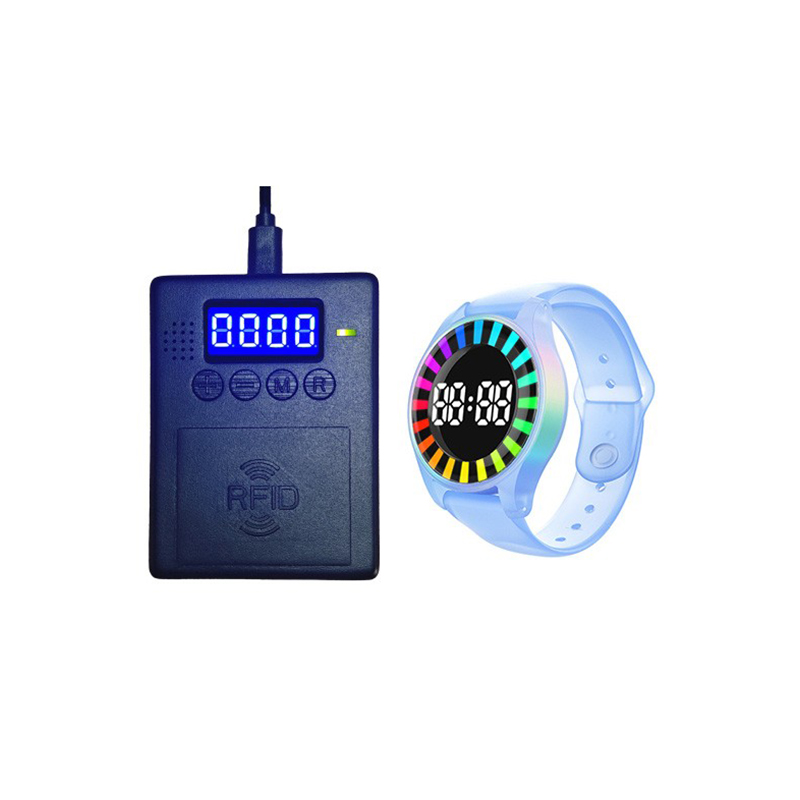
RFID countdown wristbands and timer setting equipment for timed trampoline park sessions.
Why Trampoline Parks Need RFID Timer Wristbands
Trampoline parks often operate with fixed session lengths, multiple activity zones, birthday parties, group bookings, and different ticket packages. During peak periods, employees may need to monitor many visitors who started playing at different times.
Without an individual timing device, staff may rely on wristband colors, printed tickets, manual records, or announcements. These methods can work for small operations, but they become harder to manage as visitor volume increases.
RFID timer wristbands help solve several common operational problems:
- Time confusion: Visitors can check their remaining session time directly.
- Missed reminders: LED and vibration alerts help notify guests when their session is approaching its end.
- Front-desk interruptions: Employees spend less time answering repeated questions about playtime.
- Session transitions: Visitors receive reminders that help them prepare to leave the activity area.
- Access verification: Compatible RFID readers can check whether a wristband has valid access permission.
- Reusable equipment management: Rechargeable wristbands can be collected, reset, and issued again.
For trampoline park owners, the goal is not simply to add RFID technology. It is to create a timing process that visitors understand and staff can operate consistently.
Choose a Wristband with a Clear Countdown Display
A countdown display is one of the most important features to consider when purchasing timer wristbands for a trampoline park. Visitors should be able to check the remaining time without returning to the ticket counter or asking an employee.
The display should be easy to read during normal use, and the wristband should allow guests to activate the screen when they want to check their session. A visible timer can also help parents supervise children and prepare them for the end of their jumping session.
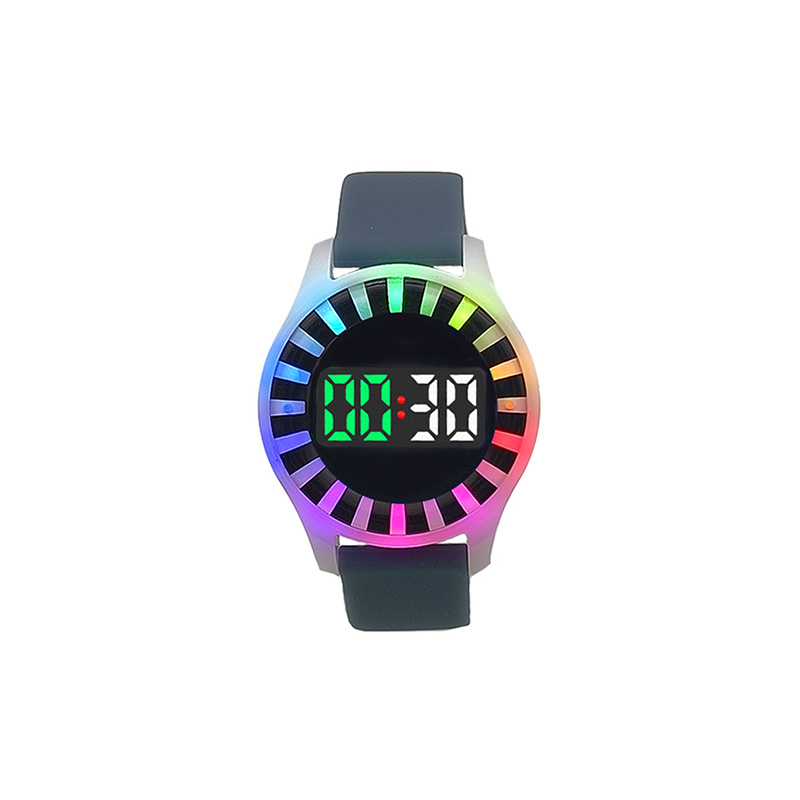
A digital countdown display allows visitors to check their remaining playtime at a glance.
When evaluating a product, ask the supplier:
- Is the remaining time displayed digitally?
- Can visitors check the display with a button?
- Is the display readable under indoor lighting conditions?
- Can the device indicate that the countdown has expired?
- Can the reminder display be customized for different session types?
The MH-CR03 RFID vibrating countdown wristband combines a digital time display, LED indicators, vibration reminders, and RFID identification for timed attractions. It is a practical option for operators who want guests to have a personal reference for their session duration.
Evaluate LED and Vibration Reminder Functions
Trampoline parks are noisy environments. Music, jumping activities, group announcements, and conversations can make it difficult for visitors to hear a verbal reminder. Staff may also be busy supervising safety or checking in another group.
For this reason, RFID timer wristbands with visual and vibration reminders can be more useful than a timer that only displays the remaining time.
Before purchasing, check how the reminder system works:
- Advance reminder: Does the wristband notify visitors before their session ends?
- LED indication: Can different colors indicate normal use, approaching expiration, or timeout?
- Vibration pattern: Does the device provide a short vibration, multiple vibrations, or a continuous alert?
- Expiration behavior: What happens when the countdown reaches zero?
- Customization: Can the reminder timing be adjusted to match the park's operating rules?
For example, a five-minute warning gives visitors time to finish their activity and prepare to leave. The park can also use the reminder as part of its standard session transition procedure.
When comparing models, consider the rechargeable LED time management wristband for trampoline parks, which is designed for countdown reminders, RFID identification, and timed entertainment applications.
Confirm the RFID Frequency and System Compatibility
RFID compatibility is one of the most important purchasing considerations, particularly if your trampoline park already uses RFID tickets, membership cards, entrance readers, or access control software.
Do not assume that every RFID wristband will work with an existing system simply because it uses RFID technology. Different frequency bands, chip types, communication protocols, and reader configurations can affect compatibility.
Before placing an order, confirm:
- RFID frequency, such as 13.56 MHz
- Chip type and memory configuration
- Supported communication protocol
- Whether the wristband UID can be registered in the existing system
- Reader compatibility at entrance and exit points
- Whether access permission and countdown information are handled by the same system or separate components
For the MH-CR03 configuration listed on the product website, the RFID frequency is 13.56 MHz. However, park owners should confirm the exact chip and protocol requirements with their system integrator before ordering, particularly when integrating with third-party turnstiles or software.
Decide Whether You Need Wristbands Only or a Complete Management System
Some trampoline parks only need wearable countdown devices. Others require a complete time and access management solution with timer setters, RFID readers, entrance turnstiles, exit turnstiles, charging equipment, and software.
The correct configuration depends on how visitors enter, how playtime starts, and how expired sessions are handled.
| System Component |
Purpose |
When It Is Needed |
| RFID Countdown Wristband |
Displays remaining time and provides reminders |
For every timed visitor |
| Timer Setter |
Writes or updates the session duration |
When staff need to program playtime |
| Entrance RFID Reader |
Verifies registration and access permissions |
For controlled entry |
| Turnstile |
Controls visitor entry based on configured rules |
For automated admission management |
| Exit Reader |
Checks exit or overtime status |
For venues with controlled exit procedures |
| Charging Equipment |
Charges multiple reusable wristbands |
For daily reusable wristband operations |
| Management Software |
Supports registration, settings, and system integration |
For larger or customized operations |
Timer setters can help staff configure wristband durations before visitors enter the activity area.
For parks that want automated entry verification, the RFID countdown wristband and turnstile system for trampoline park session management combines wearable timers with compatible access control equipment and charging components.
Match the Countdown Settings to Your Ticket Packages
Every trampoline park has its own pricing structure. Some sell fixed sessions, while others offer flexible playtime, memberships, group packages, or activity-specific tickets.
Before purchasing timer wristbands, make a list of the durations your venue actually sells. For example:
| Ticket Package |
Example Playtime |
Operational Requirement |
| Short Session |
30 minutes |
Fast activation and clear expiration reminder |
| Standard Session |
60 minutes |
Visible countdown and advance alert |
| Extended Session |
90 minutes |
Flexible duration programming |
| Special Package |
120 minutes or customized |
Confirm supported countdown range and setting method |
Some countdown wristbands support minute-based or half-hour-based time settings. Confirm the available setting increments and maximum countdown duration before purchase. This is particularly important if your park sells non-standard session lengths or requires customized timing logic.
Check Battery Life and Charging Capacity for Daily Operations
Rechargeable wristbands can be reused, but battery performance must match your park's daily operating schedule. A product that works well for a small venue may require a different charging plan when hundreds of wristbands are used during busy weekends.
When comparing battery specifications, check both operating time and standby time. Standby time does not necessarily represent how long the wristband can run with the countdown display, vibration reminders, and RFID functions actively used.
Questions worth asking the supplier include:
- How many hours can the wristband operate under normal use?
- How long does a full charge take?
- What charging method is used?
- How many wristbands can be charged at the same time?
- Can charging equipment be supplied for a large batch?
- What is the recommended charging and storage procedure?
For larger trampoline parks, charging capacity should be planned around daily wristband turnover. A charging rack or multi-port charger may help staff prepare reusable wristbands before the next operating period.
Choose Comfortable and Durable Wristband Materials
Trampoline park wristbands are worn during active movement. Visitors jump, run, sweat, and move between activity areas, so comfort and secure fastening matter.
Silicone is a common choice for reusable timer wristbands because it is flexible and suitable for wearable applications. However, operators should evaluate the actual strap design rather than focusing only on material.
Check the following before approving a sample:
- Is the wristband comfortable for children and adults?
- Can it remain securely fastened during jumping?
- Is the strap easy to clean between visitors?
- Does the clasp or buckle fit the venue's collection and reissue process?
- Are different sizes, colors, or strap styles available?
- Is the housing durable enough for the intended environment?
For venues that need a customized appearance, strap colors and branding options may also help distinguish ticket packages, activity groups, or membership categories. Customization should not interfere with the display, RFID reading, charging, or fastening functions.
Understand How the Wristbands Will Be Reused
Reusable RFID timer wristbands can reduce dependence on disposable tickets, but the park needs a clear collection and preparation process.
A typical reusable wristband workflow may include:
- Collect the wristband when the visitor finishes the session.
- Check the device for damage or missing straps.
- Clear or update the previous session's countdown and permissions.
- Recharge the wristband when necessary.
- Return the wristband to the issuing station.
- Issue the wristband to the next visitor after checking its status.
For procurement planning, consider not only the number of visitors but also the number of wristbands needed during peak periods, the time required to collect them, and the number of devices that may be charging or undergoing maintenance.
A simple inventory buffer can help prevent shortages during busy weekends, school holidays, and group events.
Compare the Total Cost of Ownership Instead of Only the Unit Price
The lowest-priced wristband may not be the most economical choice for a trampoline park. Purchasing decisions should consider the complete operating cost over the expected service life.
| Cost Factor |
Why It Matters |
| Initial wristband price |
Determines the initial equipment investment |
| Timer setters and readers |
Additional equipment may be required to program and verify devices |
| Charging equipment |
Multi-device charging may be necessary for daily turnover |
| Replacement rate |
Lost, damaged, or worn wristbands increase operating costs |
| Staff handling time |
Collection, resetting, charging, and issuing affect labor requirements |
| System integration |
Software, turnstiles, installation, and technical support may affect project cost |
For a venue with regular visitor traffic, reusable timer wristbands may provide long-term value when they are durable, easy to manage, and supported by an efficient charging and reset process. The actual savings should be evaluated using the park's purchase cost, reuse rate, maintenance requirements, and labor workflow.
A Practical RFID Timer Wristband Buying Checklist
Before requesting a quotation, trampoline park owners can prepare the following information to help suppliers recommend the correct product and system configuration.
| Requirement |
Details to Provide |
| Venue type |
Trampoline park, indoor playground, ninja course, or multi-zone activity center |
| Daily visitor volume |
Average and peak-day visitor numbers |
| Session durations |
All ticket packages and required countdown settings |
| RFID requirements |
Frequency, chip type, existing readers, or software compatibility requirements |
| Reminder functions |
LED colors, vibration patterns, advance reminder timing, and overtime behavior |
| System components |
Timer setters, readers, turnstiles, software, and charging equipment |
| Wristband customization |
Colors, logo, strap style, clasp, and packaging |
| Quantity |
Initial order, expected replacement stock, and future expansion requirements |
Providing this information in advance makes it easier to compare quotations on a like-for-like basis. It also helps suppliers identify whether a wristband-only solution or a complete time and access management system is more appropriate.
Which RFID Timer Wristband Is Suitable for Your Trampoline Park?
For trampoline park owners, the right RFID timer wristband should match the ticketing structure, visitor volume, activity layout, and existing access control system.
A small park with a simple timed-entry process may only need rechargeable countdown wristbands and a portable timer setter. A larger venue with several activity zones, scheduled sessions, and controlled entry may benefit from RFID readers, turnstiles, charging racks, and integrated software.
Meihe provides RFID countdown wristbands and related time management equipment for trampoline parks, indoor playgrounds, and other timed entertainment facilities. The MH-CR03 is designed to combine countdown display, LED reminders, vibration alerts, RFID identification, and rechargeable operation in a reusable wearable device.
To compare suitable configurations, visit RFIDCardFactory.com and provide your venue type, ticket durations, required quantity, and system integration details. These specifications will help determine the appropriate wristband model, timer setter, charging equipment, and access control configuration for your project.
Frequently Asked Questions
What is an RFID timer wristband for trampoline parks?
An RFID timer wristband is a wearable device that combines RFID identification with countdown timing and reminder functions. It allows trampoline park visitors to check their remaining playtime and receive notifications when their session is approaching its end.
What features should trampoline park owners look for?
Important features include a clear countdown display, LED reminders, vibration alerts, compatible RFID technology, rechargeable operation, comfortable straps, flexible time settings, and compatibility with the park's existing readers or access control system.
Can RFID timer wristbands support different playtime packages?
Yes. Depending on the model and timer setting method, staff can assign different countdown durations according to the purchased ticket package. Confirm the supported time increments and maximum countdown range before ordering.
Do RFID countdown wristbands require an internet connection?
Some wristbands can operate independently after the countdown duration has been programmed. However, connected readers, turnstiles, or management software may require a computer or network connection depending on the system configuration.
Can RFID timer wristbands work with entrance turnstiles?
Yes. Compatible RFID wristbands can work with readers and turnstiles to verify visitor registration and access permission. The RFID frequency, chip type, communication protocol, and access control logic should be confirmed before integration.
Are rechargeable RFID timer wristbands suitable for daily reuse?
Many models are designed for repeated use. The park should establish a process for collection, inspection, timer resetting, charging, and reissuing. Battery performance, charging time, and expected service life should be confirmed for the selected product.
How many RFID timer wristbands should a trampoline park purchase?
The required quantity depends on peak visitor volume, ticket session lengths, wristband turnover time, charging capacity, and the number of devices reserved for replacement or maintenance. Operators should calculate the number needed during the busiest operating period rather than using average daily attendance alone.
Can RFID timer wristbands be customized with a trampoline park logo?
Customization options may include wristband colors, strap styles, logos, and selected reminder settings. Confirm available customization options, minimum order quantities, production lead time, and whether customization affects the product's technical functions.
What should I request when asking for an RFID timer wristband quotation?
Provide the venue type, expected visitor volume, playtime packages, wristband quantity, RFID compatibility requirements, reminder functions, charging requirements, customization preferences, and whether readers or turnstiles are required. This information helps the supplier recommend a suitable configuration and prepare a more accurate quotation.





 Rede IPv6 suportada